
Jesus Christ is Jehovah: Why the God of the Old Testament is Not God the Father
Discover the biblical truth that Jesus Christ is Jehovah, the God of the Old Testament. Learn why prophets spoke with Christ, not the Father, and how this doctrine changes everything.
Felmore Flores
12/17/202513 min read
There's a fundamental misunderstanding that runs through almost all of modern Christianity. It's taught in churches across the world. It's preached from pulpits, written in commentaries, and assumed in Sunday school classes. And it's completely wrong.
Here's what most Christians believe. When Moses stood before the burning bush and heard the voice say, "I AM THAT I AM," they believe that was God the Father speaking. When Abraham made covenants with the Lord, they assume it was the Father. When Isaiah saw the Lord sitting upon a throne, high and lifted up, with seraphim crying "Holy, holy, holy," they think it was Heavenly Father he saw. When prophets throughout the Old Testament received revelations, commandments, and visions, traditional Christianity teaches that they were interacting directly with God the Father.
But they weren't.
The God of the Old Testament, the one who spoke to every prophet from Adam to Malachi, the covenant maker, the law giver, the creator, the voice from Sinai, the pillar of fire and cloud, was not God the Father. It was Jesus Christ. Jehovah of the Old Testament is Jesus Christ of the New Testament. They are the same being. The same voice. The same God. And if you don't understand this, you'll misunderstand almost everything about the nature of God, the roles within the Godhead, and the entire plan of salvation. Because this isn't just a minor theological detail. This changes everything. And it's a truth that The Church of Jesus Christ of Latter-day Saints has been teaching since the beginning, a truth restored through the Prophet Joseph Smith, a truth that corrects one of the most fundamental errors in Christian theology.
Let me show you why this matters and how the scriptures prove it beyond any doubt.
The Traditional Christian View and Why It's Wrong
Most Christian denominations teach some version of the Trinity, the belief that God the Father, Jesus Christ, and the Holy Ghost are three persons in one substance, one being, one God. Within that framework, they often assume that Old Testament references to God are referring to the Father, while New Testament appearances are obviously Jesus. They see the Old Testament as the Father's domain and the New Testament as the Son's arrival.
But that's not what the scriptures actually teach.
The Bible itself makes it clear, over and over again, that no man has seen God the Father at any time. John 1:18 says plainly, "No man hath seen God at any time, the only begotten Son, which is in the bosom of the Father, he hath declared him." John 6:46 records Jesus saying, "Not that any man hath seen the Father, save he which is of God, he hath seen the Father." And 1 John 4:12 repeats it again: "No man hath seen God at any time."
So if no man has seen the Father, who did Moses see? Who did Abraham see? Who did Isaiah see?
The answer is right there in the scriptures. They saw Jesus Christ. The premortal Christ. The Jehovah of the Old Testament. The God who would one day be born as a baby in Bethlehem, live a mortal life, suffer in Gethsemane, die on the cross, and rise again on the third day. That's who spoke to the prophets. That's who made covenants. That's who gave the law.
And this isn't just Latter-day Saint interpretation. This is what the Bible actually teaches when you read it carefully and let scripture interpret scripture.
Jehovah and the Burning Bush
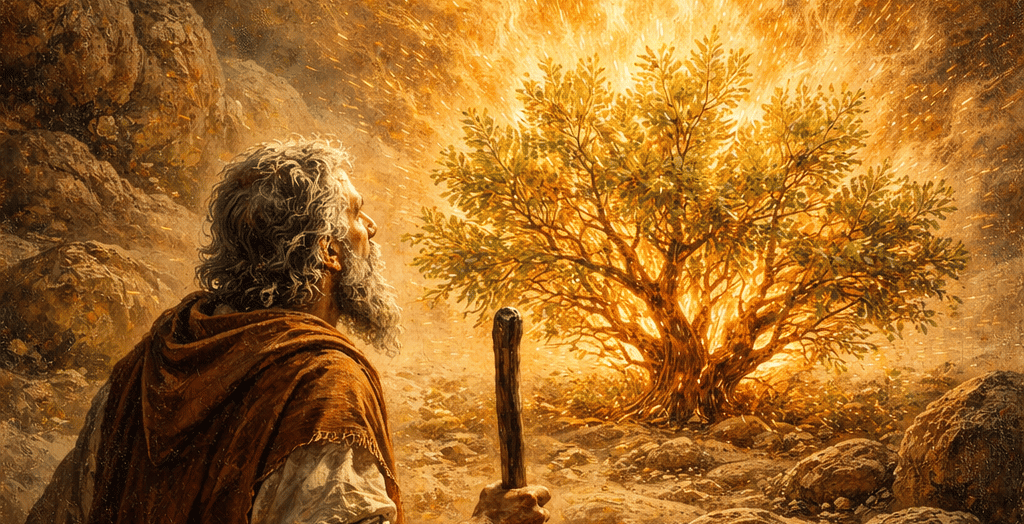
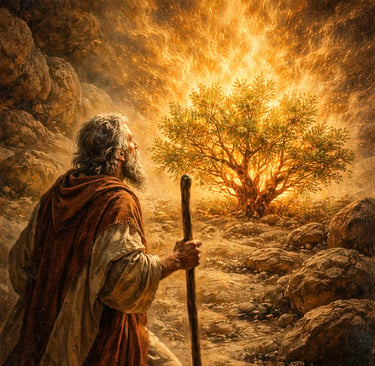
Let's start with one of the most famous moments in the Old Testament. Moses is tending his father-in-law's flock on the backside of the desert when he sees something impossible. A bush is on fire, but it's not burning up. He turns aside to look, and a voice speaks to him from the flame. The voice says, "Moses, Moses." And Moses answers, "Here am I." Then the voice says, "Draw not nigh hither: put off thy shoes from off thy feet, for the place whereon thou standest is holy ground." And then comes the declaration: "I am the God of thy father, the God of Abraham, the God of Isaac, and the God of Jacob." Moses hides his face because he's afraid to look upon God. And then the voice continues. He's seen the affliction of His people in Egypt. He's heard their cry. He knows their sorrows. And He's come down to deliver them. He's sending Moses to bring them out.
Moses asks, "Who shall I say sent me?" And the voice answers with the most famous name in all of scripture: "I AM THAT I AM." Or in Hebrew, "Ehyeh Asher Ehyeh." The self-existent one. The eternal one. The one who was, who is, and who always will be.
And then in Exodus 3:15, the voice gives another name: "Thus shalt thou say unto the children of Israel, the LORD God of your fathers, the God of Abraham, the God of Isaac, and the God of Jacob, hath sent me unto you: this is my name for ever, and this is my memorial unto all generations." That word "LORD" in all capital letters in the King James Bible is translating the Hebrew name YHWH, which we pronounce as Yahweh or Jehovah. It's the personal name of God, used over six thousand times in the Old Testament. So Moses is speaking to Jehovah. The great I AM. The God of Abraham, Isaac, and Jacob.
Now fast forward to the New Testament. In John 8:58, Jesus is in a heated debate with the Pharisees. They're questioning His authority, challenging His claims. And Jesus says something that shocks them to their core: "Verily, verily, I say unto you, Before Abraham was, I am." Not "I was." I am. Present tense. The same phrase Jehovah used at the burning bush. And the Pharisees understood exactly what He was claiming. They picked up stones to kill Him for blasphemy because Jesus was declaring that He was Jehovah, the God of their fathers, the I AM who spoke to Moses.
The voice at the burning bush was Jesus Christ. And He just told them so directly.
The God Who Led Israel
Throughout the entire journey from Egypt to the promised land, who was leading Israel? Who appeared in the pillar of cloud by day and the pillar of fire by night? Who spoke from Mount Sinai? Who gave the Ten Commandments? Who established the law of Moses? Traditional Christianity would say God the Father. But the scriptures say otherwise. In 1 Corinthians 10:1-4, Paul is talking about the Israelites in the wilderness. He says, "Moreover, brethren, I would not that ye should be ignorant, how that all our fathers were under the cloud, and all passed through the sea; And were all baptized unto Moses in the cloud and in the sea; And did all eat the same spiritual meat; And did all drink the same spiritual drink: for they drank of that spiritual Rock that followed them: and that Rock was Christ."
That Rock was Christ. Paul is saying explicitly that Jesus Christ was the one leading Israel through the wilderness. He was the spiritual Rock. He was the one providing for them, guiding them, speaking to Moses on the mountain. Not the Father. Christ. And this makes perfect sense when you understand the roles within the Godhead. Jesus Christ, under the direction of the Father, is the one who interacts with mankind. He is the mediator. He is the one who speaks. He is the face and voice of God to humanity. The Father works through the Son. Always has. Always will. That's the pattern from the very beginning.
Abraham and the Lord
In Genesis 18, three men appear to Abraham. Abraham runs to meet them, bows down, and calls one of them "Lord." He prepares a meal for them, and they eat. One of them speaks and says, "I will certainly return unto thee according to the time of life; and, lo, Sarah thy wife shall have a son." Then, as the three prepare to leave, two of them head toward Sodom while one stays behind with Abraham. And Genesis 18:17 says, "And the LORD said, Shall I hide from Abraham that thing which I do?" What follows is a conversation between Jehovah and Abraham about the destruction of Sodom and Gomorrah. Later, in Genesis 22, when Abraham is commanded to offer Isaac as a sacrifice and then stopped at the last moment, it's the angel of the LORD who speaks. But notice the language. The angel doesn't say, "God is pleased with you." He says, "Now I know that thou fearest God, seeing thou hast not withheld thy son, thine only son from me." From me. Not from God. From me.
Because the angel of the LORD was Jehovah. And Jehovah is Jesus Christ.
This pattern repeats throughout the Old Testament. The angel of the LORD appears, speaks in the first person as God, makes covenants, and delivers commandments. Traditional Christianity struggles to explain this. They try to differentiate between God and His messenger. But the text doesn't support that. The angel of the LORD is Jehovah speaking. And Jehovah is Christ.
Isaiah's Vision of the Lord
In Isaiah 6, the prophet has one of the most profound visions in all of scripture. He sees the Lord sitting upon a throne, high and lifted up. The train of His robe fills the temple. Seraphim stand above Him, each with six wings, crying out, "Holy, holy, holy, is the LORD of hosts: the whole earth is full of his glory." Isaiah is overwhelmed. He cries out, "Woe is me! for I am undone; because I am a man of unclean lips, and I dwell in the midst of a people of unclean lips: for mine eyes have seen the King, the LORD of hosts." His eyes have seen the LORD. He's seen Jehovah. He's gazed upon the glory of God. But remember what John said. No man has seen the Father at any time. So who did Isaiah see?
He saw Jesus Christ.
And we know this for certain because John himself tells us. In John 12:37-41, John is talking about the unbelief of the Jews despite all the miracles Jesus performed. And then he quotes Isaiah 6 and says, "These things said Esaias, when he saw his glory, and spake of him." When Isaiah saw the Lord on the throne, he saw Jesus' glory. He was speaking of Christ. Not the Father. Christ. Isaiah saw the premortal Savior in vision and prophesied of His mission, His rejection, and His suffering. The suffering servant of Isaiah 53, the one who was despised and rejected, wounded for our transgressions, bruised for our iniquities, is the same glorious being Isaiah saw on the throne in chapter six. Jehovah and Jesus are the same person.
The Creator of Heaven and Earth
Who created the heavens and the earth? If you ask most Christians, they'll say God the Father. But the scriptures are clear. Jesus Christ, under the Father's direction, was the creator. John 1:1-3 says, "In the beginning was the Word, and the Word was with God, and the Word was God. The same was in the beginning with God. All things were made by him; and without him was not any thing made that was made." Then verse 14 clarifies, "And the Word was made flesh, and dwelt among us." The Word is Jesus. And He made all things.
Colossians 1:16 says, "For by him were all things created, that are in heaven, and that are in earth, visible and invisible, whether they be thrones, or dominions, or principalities, or powers: all things were created by him, and for him." Hebrews 1:2 says God "hath in these last days spoken unto us by his Son, whom he hath appointed heir of all things, by whom also he made the worlds." Jesus Christ created the worlds. Under the Father's direction, yes, but by Christ's power and authority. So when Genesis 1:1 says, "In the beginning God created the heaven and the earth," that's Jehovah. That's Jesus. He spoke, and it was so. He commanded, and light appeared, land separated from water, life sprang forth.
And when Genesis 1:26 records, "Let us make man in our image, after our likeness," that's the Father and the Son speaking together, planning the creation of mankind. The Father providing the direction, the Son executing the work. Jehovah is the creator. And Jehovah is Christ.
Why This Matters So Much
You might be wondering, why does this matter? Why does it make such a difference whether the God of the Old Testament was the Father or the Son? Because it changes everything about how we understand God's plan. If the Father was the one speaking to prophets, appearing in visions, making covenants, then what was Jesus doing before Bethlehem? Was He just waiting around? Was He uninvolved in human history until His birth? No. He was actively engaged in the salvation of mankind from the very beginning.
Jesus Christ has always been our Savior. He was chosen in the premortal council to be the Redeemer. And from that moment forward, He took upon Himself the role of mediator between fallen humanity and our Heavenly Father. He spoke to the prophets. He gave the law. He made covenants. He led Israel. He prepared the way for His own mortal mission. Understanding that Jesus is Jehovah helps us see the unity and consistency of God's plan across all of scripture. It's not two different gods with two different messages. It's the same Savior, working tirelessly across millennia, preparing the world for His Atonement. The God who walked with Adam in the Garden of Eden was Jesus. The God who called Abraham was Jesus. The God who delivered Israel from Egypt was Jesus. The God who gave the law on Sinai was Jesus.
And then, in the meridian of time, that same God laid aside His glory, took upon Himself a body of flesh and blood, and was born as a baby in Bethlehem. Jehovah became Jesus. The God of the Old Testament became the man of the New Testament. The creator became the Redeemer. The law giver became the fulfillment of the law. And He did it all because He loves us.
How Latter-day Saint Doctrine Clarifies This Truth
The Church of Jesus Christ of Latter-day Saints teaches this doctrine clearly and consistently. We believe in God the Eternal Father, in His Son Jesus Christ, and in the Holy Ghost. These are three distinct beings, united in purpose, but separate in personage. The Father is the Father of our spirits. Jesus Christ is His firstborn in the spirit, our elder brother, the one chosen to be our Savior. The Holy Ghost is a personage of spirit who bears witness of truth. And we believe that Jesus Christ is Jehovah. This isn't speculation. This is revealed doctrine, taught by Joseph Smith and confirmed in modern scripture.
In Doctrine and Covenants 110:3-4, Joseph Smith and Oliver Cowdery have a vision in the Kirtland Temple. They see the Lord standing upon the breastwork of the pulpit. His eyes are as a flame of fire, His hair white like pure snow, His countenance shining above the brightness of the sun, and His voice as the sound of rushing waters. And the Lord says, "I am the first and the last; I am he who liveth, I am he who was slain; I am your advocate with the Father." He who liveth. He who was slain. That's Jesus.
And then in Doctrine and Covenants 110:7, Moses appears and commits the keys of the gathering of Israel. Then Elias appears and commits the dispensation of the gospel of Abraham. Then Elijah appears and commits the keys of the sealing power. Three Old Testament prophets appearing, confirming that the Jesus they're now seeing in vision is the same Jehovah they knew and worshipped in their mortal lives. In Doctrine and Covenants 29:1, Jesus introduces Himself: "Listen to the voice of Jesus Christ, your Redeemer, the Great I AM, whose arm of mercy hath atoned for your sins." The Great I AM. The name from the burning bush. Jesus is claiming that title directly.
And in 3 Nephi, when the resurrected Christ appears to the Nephites, He says in chapter eleven, verse ten, "Behold, I am Jesus Christ, whom the prophets testified shall come into the world." And in 3 Nephi 15:5, He says, "Behold, I am he that gave the law, and I am he who covenanted with my people Israel." I gave the law. I covenanted with Israel. That's Jehovah speaking. And Jesus is saying, that was me. This isn't hidden. This isn't obscure. This is clear, direct, revealed truth. Jesus Christ is Jehovah. He always has been. And understanding this transforms how we read the Old Testament, how we understand the Godhead, and how we see the magnificent consistency of God's plan from beginning to end.
Correcting the Error
So why does most of Christianity get this wrong? How did this confusion happen? Part of it comes from the doctrine of the Trinity, which blurs the distinction between the Father, Son, and Holy Ghost into one mysterious, incomprehensible being. When you believe God is one substance in three persons, it becomes difficult to explain how Jesus could be God before He was born. It creates theological knots that require centuries of philosophical explanations to untangle.
But Latter-day Saints don't have that problem. We believe the Father, Son, and Holy Ghost are separate beings, united perfectly in purpose and will, but distinct in personage. That clarity allows us to see the truth that's been in the Bible all along. Jesus Christ, as Jehovah, has always been the one interacting with mankind. The Father works through the Son. The Son speaks for the Father. And the Holy Ghost testifies of both. It's not complicated once you have the correct framework.
And this matters because if people misunderstand who they're worshipping, if they misunderstand the roles within the Godhead, they'll misunderstand the plan of salvation itself. They'll miss the beauty of a Father who loved us enough to send His Son. They'll miss the Savior who loved us enough to leave His glory, take on mortality, and suffer for our sins. They'll miss the whole point.
So when we teach that Jesus is Jehovah, we're not just splitting theological hairs. We're restoring a fundamental truth that was lost. We're helping people see the scriptures clearly. We're correcting an error that's led millions away from understanding who God really is and how He saves us.
Worship Jehovah, Worship Jesus
Here's the bottom line. Every time you read the Old Testament and see the name LORD in all capitals, that's Jehovah. That's Jesus Christ. The voice that spoke to Moses was His voice. The glory Isaiah saw was His glory. The covenant maker, the law giver, the creator, the deliverer, was Him. And then, two thousand years ago, that same God humbled Himself, took on flesh, and was born in a stable. He grew up in Nazareth, taught in Galilee, healed the sick, raised the dead, and ultimately gave His life on the cross. He suffered in Gethsemane for every sin, every pain, every sorrow. And on the third day, He rose again, conquering death and making salvation available to all. Jehovah became Jesus so that Jesus could save us.
And when we worship Jesus, we're worshipping the same God Abraham worshipped. The same God Moses knew. The same God Isaiah saw. We're worshipping Jehovah, the great I AM, the one who was, who is, and who is to come. He's not a different God. He's the same God who's been working for our salvation from the very beginning. So read the Old Testament with new eyes. See Jesus on every page. Hear His voice in every revelation. Recognize His hand in every covenant. Because He's there. He's always been there. And He always will be.
Jesus Christ is Jehovah. And that changes everything.
Did this change how you see the Old Testament? Share this post with someone who's been taught differently. Let's spread this truth. And let's worship the Savior who's been saving us from the very beginning.
💙 Comment below: What's one Old Testament story that makes more sense now that you know Jesus is Jehovah?
© 𝘍𝘦𝘭𝘮𝘰𝘳𝘦 𝘍𝘭𝘰𝘳𝘦𝘴 2025. 𝘈𝘭𝘭 𝘳𝘪𝘨𝘩𝘵𝘴 𝘳𝘦𝘴𝘦𝘳𝘷𝘦𝘥.
𝘍𝘦𝘦𝘭 𝘧𝘳𝘦𝘦 𝘵𝘰 𝘴𝘩𝘢𝘳𝘦 𝘵𝘩𝘪𝘴 𝘱𝘰𝘴𝘵 𝘶𝘴𝘪𝘯𝘨 𝘵𝘩𝘦 𝘴𝘩𝘢𝘳𝘦 𝘣𝘶𝘵𝘵𝘰𝘯, 𝘣𝘶𝘵 𝘥𝘰 𝘯𝘰𝘵 𝘤𝘰𝘱𝘺 𝘰𝘳 𝘳𝘦𝘱𝘰𝘴𝘵 𝘵𝘩𝘦 𝘤𝘰𝘯𝘵𝘦𝘯𝘵 𝘸𝘪𝘵𝘩𝘰𝘶𝘵 𝘤𝘭𝘦𝘢𝘳 𝘤𝘳𝘦𝘥𝘪𝘵 𝘰𝘳 𝘱𝘦𝘳𝘮𝘪𝘴𝘴𝘪𝘰𝘯.
Join Us!
Connect
Feel free to follow my socials anytime
info@felmorewritings.com
© FelmoreWritings2025. All rights reserved.