
What Your Temple Recommend Really Represents: Worthiness, Fear, and Faith in Progress
Your temple recommend is more than a card—it reflects faith in progress, not perfection. Explore worthiness, fear, repentance, and the true purpose of the temple.
Felmore Flores
12/19/20256 min read

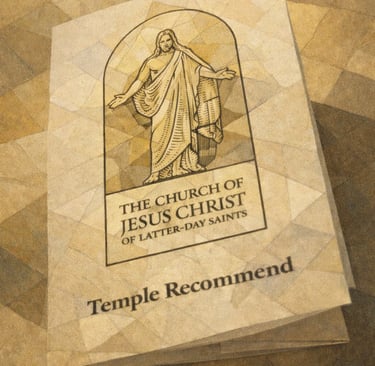
Your temple recommend sits in your wallet right now. Maybe it’s crisp and new, the ink barely dry from a recent interview. Maybe it’s worn, bent at the corners, carried through years of life changes, callings, mistakes, repentance, and quiet victories. Maybe you just renewed it. Maybe you’ve noticed the expiration date creeping closer and you’ve been avoiding thinking about it. However long it’s been there, that small card occupies a sacred space in our lives, often without us fully realizing what it represents.
For most members of the Church, the temple recommend is practical. It’s something you present at the desk, something you make sure you haven’t forgotten before leaving the house, something you tuck back into your wallet when you’re done. We schedule the interview, answer the questions, receive the signatures, and move on. It becomes procedural. Familiar. Almost routine. And yet, when you slow down and really consider it, the temple recommend is anything but ordinary.
Behind that card are questions that cut to the core of discipleship. Questions about faith in Jesus Christ, not as an abstract belief but as a living relationship. Questions about honesty, about integrity when no one is watching. Questions about obedience, moral cleanliness, sustaining leaders, keeping covenants, striving to live the gospel in a world that constantly pulls us in the opposite direction. These are not surface-level questions. They are soul-level questions.
For some people, answering them feels natural. Their lives align neatly with the expectations. Their habits are established, their testimonies feel steady, their choices largely consistent. The recommend, for them, feels like a confirmation of a path they’re already confidently walking. There is gratitude, yes, but little inner conflict. The interview feels peaceful. Reassuring.
But for many others, the experience is far more complicated.
For some, every temple recommend interview feels like standing under a spotlight. Not because they are rebellious or careless, but because they are deeply aware of their weaknesses. They know exactly where they struggle. They know which commandments feel heavier, which habits are harder to break, which questions require a pause before answering. They leave the interview with a valid recommend in hand, but also with a quiet weight in their chest—a feeling that they barely made it, that they passed but not confidently, that their worthiness feels fragile.
There are members who carry their temple recommend alongside a persistent sense of guilt. Not always because they are unworthy, but because they fear they are not worthy enough. They worry that their private struggles somehow disqualify them from sacred spaces. They wonder if they are deceiving others, or worse, deceiving themselves. Outwardly, they look faithful. Inwardly, they wrestle.
And that raises an important question that many of us are afraid to ask out loud. Is your temple recommend a reflection of where you are, or where you are trying to be?
That distinction matters more than we often acknowledge.
The gospel of Jesus Christ has always been about direction, not perfection. Repentance itself is evidence of faith, not failure. The Savior did not teach that disciples would arrive fully formed and flawless at the gate of holiness. He taught of growth, of becoming, of line upon line and precept upon precept. Yet somewhere along the way, many members have internalized the idea that worthiness means having everything together.
Worthiness, in practice, has slowly begun to feel like flawlessness instead of faithfulness.
This misunderstanding creates a quiet crisis among many faithful Latter-day Saints. People who love the gospel. People who pray. People who serve. People who are sincerely trying to follow Christ—but who feel perpetually inadequate. They attend church, magnify callings, sustain leaders, and still carry the fear that if anyone truly knew them, they would be exposed as less than worthy.
That fear doesn’t come from doctrine. It comes from comparison. From cultural expectations. From stories we tell ourselves about what righteousness is supposed to look like.
The temple recommend interview was never meant to be a courtroom. It was never meant to be an interrogation designed to catch people failing. It is meant to be a moment of reflection, honesty, and accountability—a checkpoint along the covenant path. A space to evaluate not whether you are perfect, but whether you are striving, repenting, believing, and turning toward Christ.
Elder Jeffrey R. Holland once taught that God “is not waiting at the finish line to see if we made it; He is with us every step of the way.” That truth changes how we understand worthiness. If God walks with us in our weakness, then worthiness cannot mean the absence of struggle. It must mean the presence of humility and a willingness to keep moving forward.
And yet, how many members have chosen not to attend the temple—even with a valid recommend—because they didn’t feel spiritual enough that day?
How many have stayed home because they felt too distracted, too stressed, too imperfect to enter the House of the Lord?
This is more common than we admit.
There are days when faith feels strong and steady, when prayers feel natural and scripture study feels nourishing. There are also days when faith feels thin, when prayers feel mechanical, when the noise of life drowns out the Spirit. The question is not whether those days disqualify us, but whether we mistakenly believe they do.
The temple was never designed only for the spiritually confident. It is a place of healing, instruction, and renewal. It is where covenants are remembered and strengthened, not where people go to prove they have already mastered discipleship. When we avoid the temple because we don’t feel worthy enough, we misunderstand its purpose.
Jesus Christ consistently welcomed those who felt inadequate. He ate with sinners. He healed the broken. He spoke most tenderly to those who knew they needed Him. He reserved His sharpest words not for the struggling, but for those who believed their outward righteousness made them superior.
If the Savior Himself did not require perfection before offering grace, why do we assume the temple does?
That small card in your wallet is not a badge of spiritual superiority. It is not proof that you are better than others. It is not evidence that you have arrived. It is a symbol of covenant. A reminder that you have chosen to bind your life to Christ, even when it’s hard, even when you stumble, even when you are still learning.
President Russell M. Nelson has repeatedly taught that the temple is central to our spiritual survival, especially in troubled times. Survival implies struggle. Growth implies effort. Endurance implies opposition. The covenant path was never meant to be smooth, and the temple recommend was never meant to imply that it is.
Perhaps the more honest question isn’t, “Am I worthy?” but “Am I willing?”
Am I willing to repent when I fall short? Am I willing to be honest with God and with my leaders? Am I willing to keep trying even when progress feels slow? Am I willing to believe that Christ’s grace applies to me, not just to others?
When worthiness is framed as willingness, the burden shifts. The temple recommend becomes less about fear and more about faith. Less about measuring up and more about moving forward.
There are members who barely renew their recommend because they are in the middle of change. They are breaking habits. Healing wounds. Relearning how to trust God. Their answers in the interview are not casual or easy, but sincere. They qualify not because they are flawless, but because they are honest and committed to growth.
That kind of worthiness is deeply Christlike.
The danger comes when we create an unspoken hierarchy of righteousness, where those who struggle quietly feel inferior to those who appear effortlessly faithful. In reality, many of the people who seem strongest have simply learned how to hide their battles better. The gospel was never meant to reward appearances.
The Lord looks on the heart. He always has.
So what does your temple recommend represent?
It represents covenants you are trying to honor, even when you fall short. It represents faith that keeps choosing Christ, even when doubts whisper loudly. It represents repentance in motion, not righteousness completed. It represents a relationship with God that is alive, dynamic, and still unfolding.
If you carry your recommend with quiet fear, you are not alone. If you sometimes feel like you barely qualify, you are not broken. If you have ever skipped the temple because you didn’t feel “ready enough,” you are not a failure.
You are human. And more importantly, you are exactly the kind of person the Savior invites closer.
The temple is not a reward for the perfect. It is a refuge for the faithful. Faithful not in the sense of never falling, but in the sense of never giving up. Faithful in continuing to believe that Christ’s atonement is sufficient, personal, and real.
One day, that card will expire. It always does. But the covenants it represents do not vanish with a date printed in ink. They remain written on the heart. They continue to shape who we are becoming.
So maybe the question isn’t whether you feel worthy of your temple recommend. Maybe the better question is whether you trust the Savior enough to believe that He knew exactly who you were when He invited you onto this path.
And if He still wants you here, still welcomes you into His house, still offers you His grace—then perhaps your recommend is doing exactly what it was meant to do.
© 𝘍𝘦𝘭𝘮𝘰𝘳𝘦 𝘍𝘭𝘰𝘳𝘦𝘴 2025. 𝘈𝘭𝘭 𝘳𝘪𝘨𝘩𝘵𝘴 𝘳𝘦𝘴𝘦𝘳𝘷𝘦𝘥.
𝘍𝘦𝘦𝘭 𝘧𝘳𝘦𝘦 𝘵𝘰 𝘴𝘩𝘢𝘳𝘦 𝘵𝘩𝘪𝘴 𝘱𝘰𝘴𝘵 𝘶𝘴𝘪𝘯𝘨 𝘵𝘩𝘦 𝘴𝘩𝘢𝘳𝘦 𝘣𝘶𝘵𝘵𝘰𝘯, 𝘣𝘶𝘵 𝘥𝘰 𝘯𝘰𝘵 𝘤𝘰𝘱𝘺 𝘰𝘳 𝘳𝘦𝘱𝘰𝘴𝘵 𝘵𝘩𝘦 𝘤𝘰𝘯𝘵𝘦𝘯𝘵 𝘸𝘪𝘵𝘩𝘰𝘶𝘵 𝘤𝘭𝘦𝘢𝘳 𝘤𝘳𝘦𝘥𝘪𝘵 𝘰𝘳 𝘱𝘦𝘳𝘮𝘪𝘴𝘴𝘪𝘰𝘯.
If this reflection resonated with you, you may want to explore my books where I expand on these ideas more deeply.


Connect
Feel free to follow my socials anytime
info@felmorewritings.com
© FelmoreWritings2025. All rights reserved.